Social Enterprise Planning Guide
From: xmergnc, 11 months ago

Guide to social enterprise planning
SlideShare Link

 (Click the photo above and try the hyperlinks that you want to browse)
 (Please wait for a while and you can see all photos downloaded into page)
 (you may click and open the above 2 files and see the photos displayed interactively)
 It spent so much time to accompanish the tasks, especially in the linkages between .swfs, fused with more than 2 elements. The plan that I made the tasks into 5 pages had beated me down, since I was unfamilar to operate the commands of flash. I have decided few pages constucted with photos, however I could not combine them into a smooth file with one swf. I spent many hours to do it, and attempted many times by trial and error. Eventually, maybe I buy some books to follow the instruction. Here, I posted the background of my travelling experience, and it shoud be inserted into my main swf, probably I would try again later to make my task completed.
  (download it for a while, and you may use mouse click below the screen to see it)
 (please click on the upper photo to down the .swf and try it)
 (please click on the upper photo to download .swf and try it)
 2. Route and Map: I would use the technique that I learnt during the learning session. Posting photos and description is attached with the pointer over the places of interest. A route of my journey may be stated with a distinct line over the map. Several sceneries are used to introduce my journey and provide basic information on traveling.
3. Dairy: unique and precious experience is disclosed to share with viewers with sentimental approach since the reader may get interested in first impression, not just only searching traveling hints with informative mind.
 4. Gallery: lots of attractive images and photos are posted as a pool so that the viewers can find something interesting by a glance of searching. Graphic information can enchant the viewers to pay attention on it.

5. Other information: I believe that no one can manage all the things that are enough for someone to fulfill the searching need, more importantly, further information should be provided as hyperlinks or websites as one’s preference.

 The template of main page was my important part to finish since the viewer could use mouse click to enter into each page attributed to different topic, such as Route and Map, Diary, Gallery and so on. The shape and pattern of page was done with reference to my planner so that it may be a user-friendly guide within it. You will see below template that is separated into 4 parts. The left corner one is stated as the topic on that page. Below column on the left is scattered with several buttons, with the purpose of first impression by photos and cultural music. For the largest area one with grey color, the content with attractive photos and images will be presented. Lastly, at the right hand side, you can see 5 labels that are used to guide someone browsing each page with separated topic.
 I attempted to insert music into the button and then made the photos changed one by one vividly. I hope to build up several buttons on the map, and the viewer could click on the button scattered on the map for previewing of Egypt’s sceneries.
 By the design of webpage for the topic, I prefer to create a foundation page with background template and put all designed pages pasted onto it, and make individual button attributed to each page for browsing by viewer’s preference. Therefore, the foundation page would be unified and enclosed common elements, such as background music, buttons and images in a same area. I made a link of my contact at the upper right corner for information exchange (however, it has not functioned yet). Lastly, I posted my website of blog and course’s name on the below and then someone could browse into my blog site to view the building process for this representation.


 Dual Coding theory identified three types of processing: (1) representational, the direct activation of verbal or non-verbal representations, (2) referential, the activation of the verbal system by the nonverbal system or vice-versa, and (3) associative processing, the activation of representations within the same verbal or nonverbal system. A given task may require any or all of the three kinds of processing.
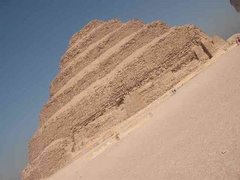
  One photo had been taken from Zoser's step-pyramid at Saqqarah. However, how I use this picture to demonstrate attractive learning object for my representation?
 Interesting photo from Egypt, however, what type of theme or organizational plan to show this picure? Creating specific pages for collection of photos or something creative presentation?